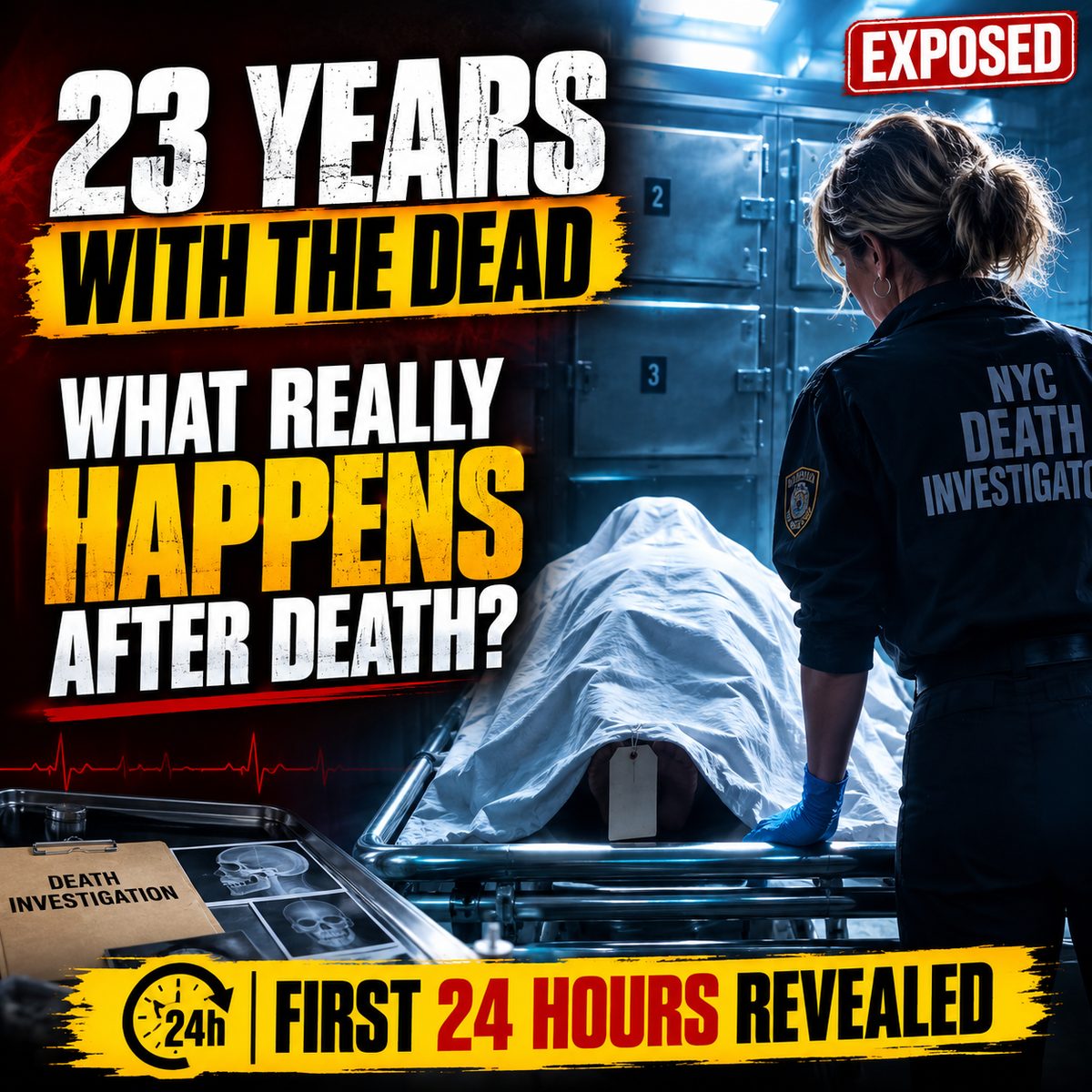
Death is one of the few universal experiences no one gets to talk about afterward, which is exactly why so many people are quietly fascinated by what actually happens once the heart stops. For most of us, the subject stays firmly in the “too morbid to ask about” category. But for Barbara Butcher, it was a full-time job for more than two decades — and she's finally pulling back the curtain on what really goes on inside a body in the first 24 hours after death.
Butcher spent 23 years working as a death investigator for the New York City Office of the Chief Medical Examiner, a role that put her at some of the most harrowing scenes imaginable, including the recovery and identification efforts following the September 11 attacks on the World Trade Center. If anyone has earned the right to talk candidly about death, it's her.
In a recent sit-down interview posted on YouTube, Butcher walked viewers through exactly what happens to human remains in the hours immediately following death — and the details are as scientifically fascinating as they are unsettling.
Why The First 24 Hours Matter So Much
For a death investigator, the first day after someone dies isn't just biologically significant — it's professionally critical. The changes a body goes through in this window are one of the main tools investigators use to estimate time of death, which can be the difference between solving a case and hitting a dead end (pun very much intended).
Butcher explained that her job largely revolved around reading the body like a clock. Every stage of physical change, from stiffening muscles to shifting blood, tells a story about how long ago someone passed away. It's a skill built on pattern recognition, science, and — as she describes it — a lot of hands-on experience with things most people will never see in their lifetime.
Stage One: Rigor Mortis Sets In
The most well-known post-death change is rigor mortis, the temporary stiffening of the body's muscles. Contrary to what most people assume, rigor mortis doesn't hit the entire body all at once. It's a gradual process that starts small and spreads.
According to Butcher, the stiffening typically begins in the smaller muscle groups first — the jaw, the neck, and the fingers — before eventually working its way into the larger muscles of the body. This progression isn't random. It follows a fairly predictable pattern that experienced investigators can use to their advantage.
“It happens over time. It's a progression,” Butcher explained, noting that a body will typically reach full rigor within eight to ten hours after death. From there, the body generally stays in that fully stiffened state for roughly another twelve hours before gradually beginning to soften again as the chemical processes driving the stiffness start to break down.
This means that within the first 24 hours, a body can move through almost the entire rigor mortis cycle — from flexible, to rigid, to starting the process of relaxing once more. For someone trained to notice it, the specific muscle groups affected and the degree of stiffness present can help narrow down a fairly precise window for when death occurred.
Butcher noted that she could often tell whether a body was heading into rigor or coming out of it based on which muscles were affected and to what degree — a skill that became second nature after years in the field, but one that takes serious training and exposure to develop.
Why Rigor Mortis Happens At All
For those wondering about the science behind it, rigor mortis is caused by chemical changes at a cellular level. When a person is alive, muscle cells constantly use a molecule called ATP to allow muscle fibres to contract and relax. Once death occurs, the body stops producing ATP, and without it, the proteins responsible for muscle movement — actin and myosin — essentially get locked in place. This is what creates that characteristic stiffness.
Eventually, as the body's cells begin to break down through natural decomposition, those chemical bonds deteriorate, and the rigidity fades. That's why rigor mortis is temporary rather than permanent, even though it can feel like a strange and unsettling process to imagine.
Stage Two: Bacteria Takes Over
While rigor mortis is happening on the outside, something equally significant is happening on the inside — and according to Butcher, it happens fast. Within the first 24 hours, bacteria in the body essentially runs wild.
While a person is alive, the immune system keeps the trillions of bacteria that naturally live in and on the human body in check. The moment death occurs, that regulation disappears. With no immune system left to hold them back, bacteria — particularly the kind that live in the gut — begin multiplying rapidly and spreading through the body's tissues.
This bacterial activity is one of the earliest drivers of decomposition. It's also part of the reason bodies begin to change colour, develop odours, and undergo other visible transformations relatively quickly after death, particularly in warmer environments.
Location, Temperature, And Season All Matter
One point Butcher was keen to stress is that there's no single, universal timeline for what happens after death. The specifics — how fast rigor mortis sets in, how quickly bacterial decomposition becomes visible, how the body's appearance changes — depend heavily on environmental conditions.
Where a person is located when they die, the ambient temperature, and even the time of year can all speed up or slow down these processes significantly. A body in a hot, humid climate will decompose far more quickly than one in a cold, dry environment. This is actually one of the fundamental principles used in forensic science: investigators don't just look at the body in isolation, they look at the body in the context of its surroundings.
This is also why forensic pathologists and investigators often work with a range of clues — body temperature, lividity (the pooling of blood due to gravity), the degree of rigor, insect activity, and environmental data — rather than relying on any single indicator to establish time of death. Butcher's expertise lay in reading all of these signs together to build the most accurate picture possible.
Who Is Barbara Butcher?
Butcher isn't just a talking head sharing internet-friendly trivia — she's one of the most respected names in American forensic investigation. During her 23-year tenure at the New York City Office of the Chief Medical Examiner, she became known for her calm, methodical approach to some of the city's most difficult cases.
Her most high-profile and emotionally taxing work came in the aftermath of September 11, 2001, when she was part of the team responsible for the painstaking task of recovering and identifying victims of the World Trade Center attacks. It's the kind of work that requires not just scientific expertise but an extraordinary amount of emotional resilience.
Since retiring, Butcher has become something of a public educator on the realities of death and forensic science, sharing her decades of firsthand experience through interviews, books, and now video content aimed at demystifying a subject most people avoid.
Why This Kind Of Content Resonates With So Many People
There's a reason content like this consistently performs well online — true crime, forensic science, and death-related education have become some of the most engaged-with genres across YouTube, podcasts, and social media over the last several years. Shows built entirely around forensic pathology, real-life death investigators, and true crime breakdowns have amassed enormous, loyal audiences.
Part of the appeal is simple curiosity. Death is something every person will eventually experience, yet it remains one of the least discussed topics in everyday life. Hearing directly from someone who spent decades working with the dead offers a rare, grounded perspective — free from horror-movie exaggeration and instead rooted in real biology and lived professional experience.
There's also an educational angle. Understanding what happens to the body after death can be genuinely useful information, whether it's satisfying general curiosity, helping someone process grief, or simply making an uncomfortable topic feel a little less mysterious and a little more human.
The Bigger Picture: What This Teaches Us About Forensic Science
Butcher's breakdown of the first 24 hours after death is also a useful window into how forensic science actually works in practice, as opposed to how it's often dramatized on television. Real investigative work isn't about flashy technology solving a case in minutes — it's about patient, methodical observation of biological processes that unfold in predictable, science-backed stages.
The progression of rigor mortis, the spread of bacterial activity, and the influence of environmental factors are all pieces of a much larger puzzle that trained professionals use to answer one of the most important questions in any death investigation: when did this person die?
For investigators like Butcher, that question isn't just academic. Establishing an accurate time of death can be crucial for identifying victims, corroborating or disproving witness accounts, and ultimately helping bring closure to grieving families or, in some cases, helping bring perpetrators to justice.
Final Thoughts
It's not every day you get a first-hand, expert breakdown of exactly what happens to the human body after death, delivered by someone who spent over two decades doing the work in one of the busiest medical examiner's offices in the world. Barbara Butcher's insight into rigor mortis, bacterial breakdown, and the many variables that affect decomposition offers a rare, honest look at a subject most people spend their whole lives avoiding.
Whether you're drawn to it out of scientific curiosity, a fascination with true crime, or simply a desire to understand more about the natural world, Butcher's decades of frontline experience make for one of the more compelling — and educational — deep dives into what really happens after we die.