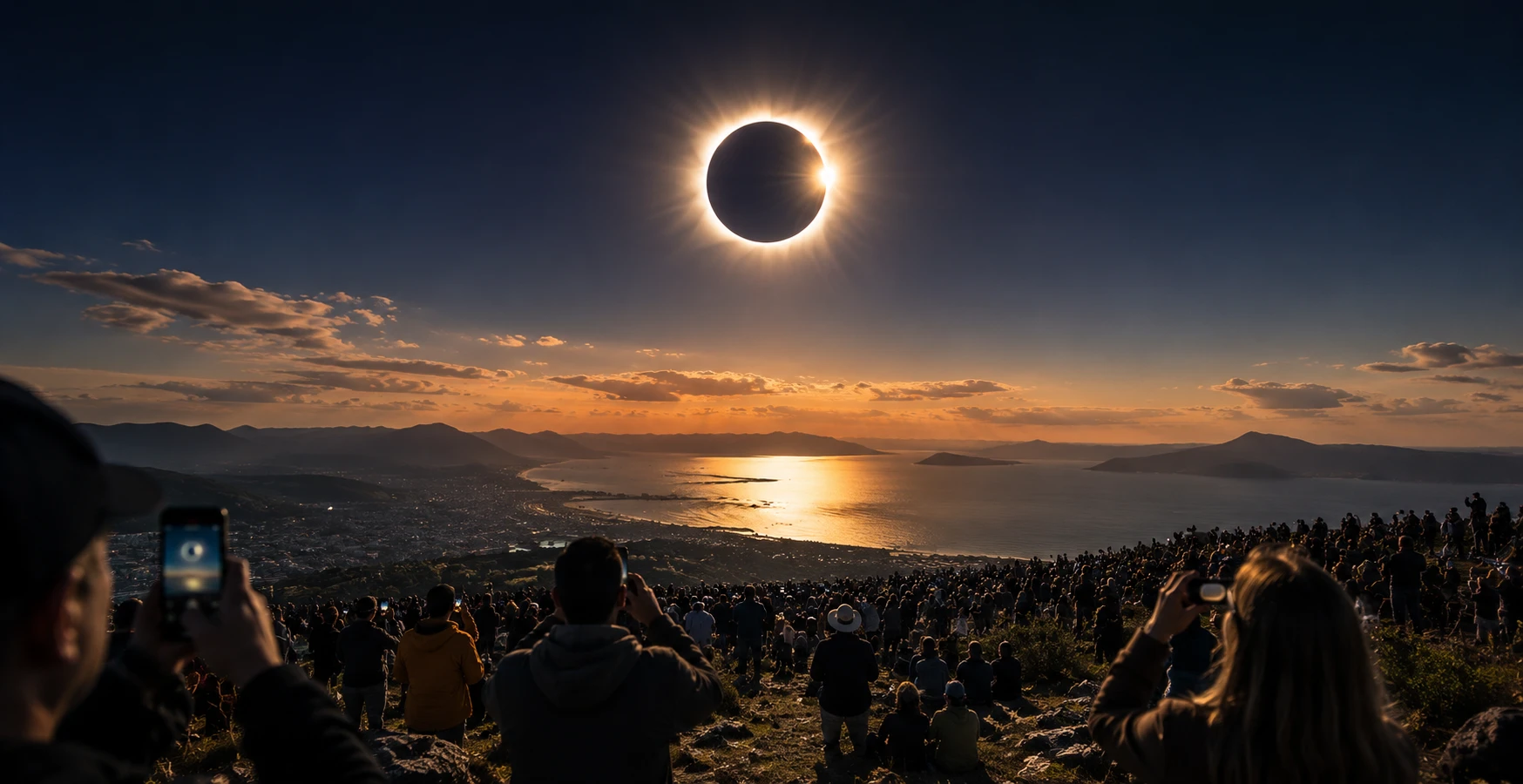
Crowds gathered across northern Spain, Iceland and Greenland on August 12 to witness the year's only total solar eclipse, an event that marked the first total eclipse visible from mainland Europe since 1999 and the first seen from continental European Union territory since 1999. The path of totality traced a dramatic route starting over Siberia, arcing across the North Pole, down the eastern coast of Greenland, past western Iceland, and finally across the Atlantic to fade out over northern Spain just before sunset.
Totality lasted less than two minutes for most viewers positioned directly in the Moon's shadow, but the effect was striking wherever it occurred: skies went fully dark in the middle of the day, temperatures noticeably dropped, and in several locations observers reported animals reacting as though night had suddenly fallen. Cities including A Coruña, Valencia, Zaragoza, Palma and Bilbao fell within the path of totality, while both Madrid and Barcelona sat just outside it, leaving those cities with only a deep partial eclipse.
Watched Across Two Continents
While the total eclipse itself was confined to a narrow band, a much wider partial eclipse was visible across a huge swath of the Northern Hemisphere, including all of Europe, North Africa, parts of Asia, and much of North America. In the United States, the partial eclipse was visible primarily in northern and northeastern states, with cities like Boston, Philadelphia, Washington D.C. and Portland catching a modest bite taken out of the Sun in the early afternoon hours.
Because the eclipse occurred just over two days after the Moon reached its closest point to Earth this month, its apparent size was slightly larger than average, intensifying the darkness experienced during totality. NASA and the European Space Agency both released detailed path maps ahead of the event, and safety officials repeatedly urged the public to use certified eclipse glasses meeting the ISO 12312-2 standard for any direct viewing outside the brief window of full totality.
Looking Ahead to the Next One
Total solar eclipses occur roughly every 18 months somewhere on Earth, but any single location typically waits centuries between events. Europe won't have to wait nearly that long for its next one: a total solar eclipse is set to cross Spain, North Africa and the Middle East on August 2, 2027, followed by an annular eclipse visible from South America, Portugal and Spain in January 2028.
For American eclipse chasers, the wait is considerably longer. The next total solar eclipse to touch US soil won't arrive until 2044, and even then it will only be visible from Montana, North Dakota and South Dakota, with a more widely accessible coast-to-coast eclipse not expected again until 2045.