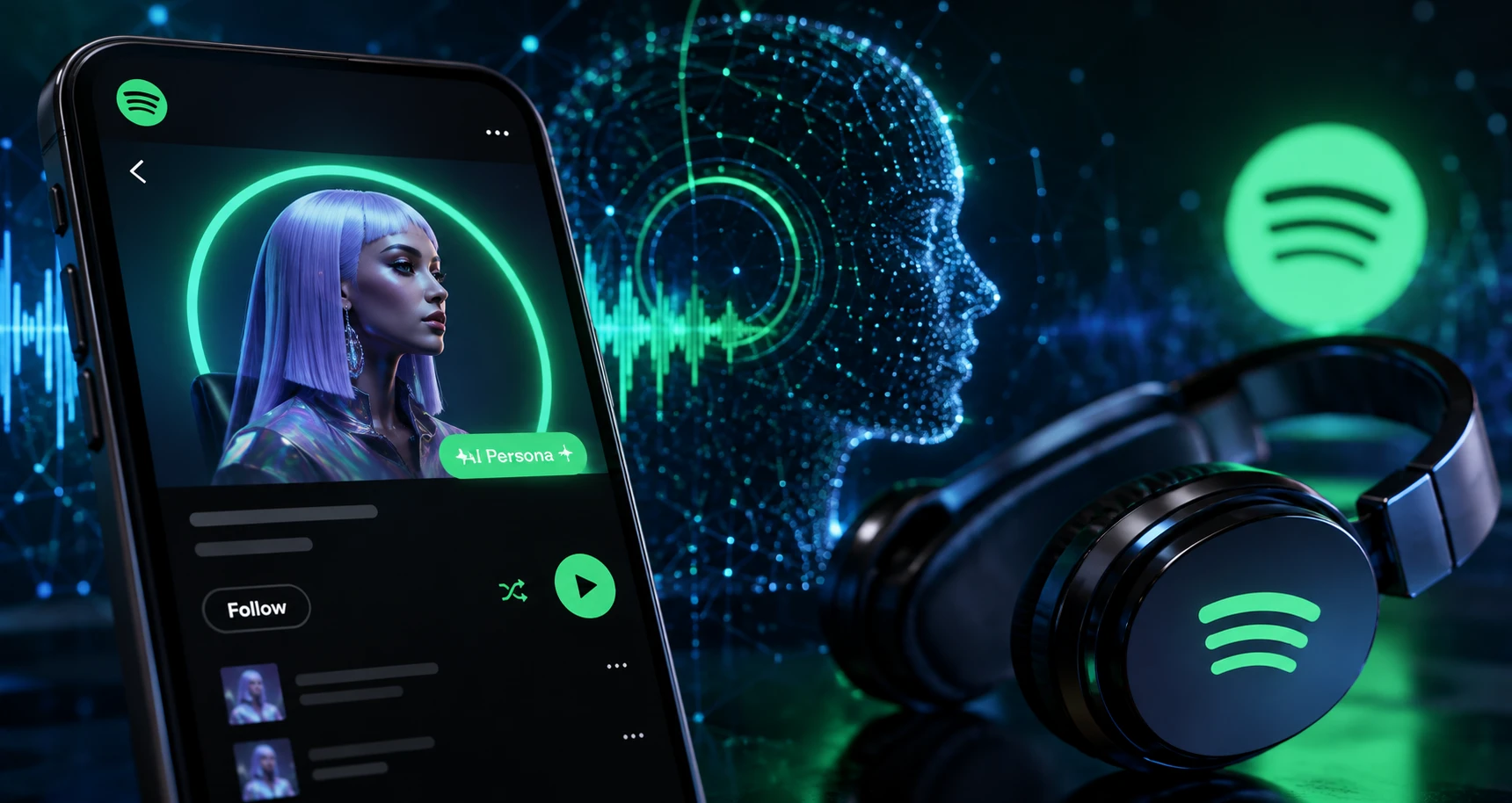
Spotify announced this week that it will begin labeling artist profiles with a new "AI Persona" badge starting in mid-September, targeting cases where an artist's public identity — rather than necessarily the music itself — appears to be entirely AI-generated. The badge will show up on the artist's profile page, in relevant search results, and within playlist track listings, giving listeners a clear signal when they're following an act that isn't actually a real person.
Crucially, Spotify says the distinction is about identity, not production process. An artist who uses AI tools somewhere in their songwriting or production workflow won't automatically be flagged; the badge is reserved specifically for profiles where the artist's name and imagery represent a photorealistic AI-generated persona rather than a real human being building a career in music.
How It Will Work
Spotify says it won't rely solely on artists disclosing their own AI status, though the platform will let artists voluntarily identify as AI Personas through Spotify for Artists. The company will also actively review profiles itself, using detection methods to flag cases it believes represent synthetic identities. Artists who are flagged will be notified and given a chance to appeal if they believe the label was applied incorrectly.
Perhaps the most consequential part of the announcement is that AI Persona profiles will be excluded from Spotify's editorial and algorithmic recommendations by default, meaning they won't appear in playlists like Discover Weekly or Release Radar unless a listener has specifically chosen to follow them. Since those recommendation systems are often the primary way independent artists without major label backing reach new listeners, the change effectively narrows AI Personas' path to organic growth while leaving their music fully accessible to anyone who seeks it out directly.
Part of a Bigger Industry Push
The move builds on a broader Artist Identity & Trust initiative Spotify has been rolling out over the past year, including verification badges, AI-generated music detection tools, and protections against unauthorized AI voice clones and deepfakes. It also arrives shortly after the EU AI Act's transparency requirements for AI-generated audio became enforceable across all 27 member states on August 2, and about a month after a coalition including the RIAA and IFPI proposed voluntary AI labeling standards for streaming platforms industry-wide.
The policy follows growing listener discomfort with synthetic acts, most notably the controversy around The Velvet Sundown, an AI-generated band that racked up millions of streams last year while posing as a real group, even landing on algorithmic playlists with hundreds of thousands of followers. In its announcement, Spotify said its programming is focused on elevating music from authentic artists building real careers, framing the new badge as a matter of basic transparency rather than a judgment on AI as a creative tool.