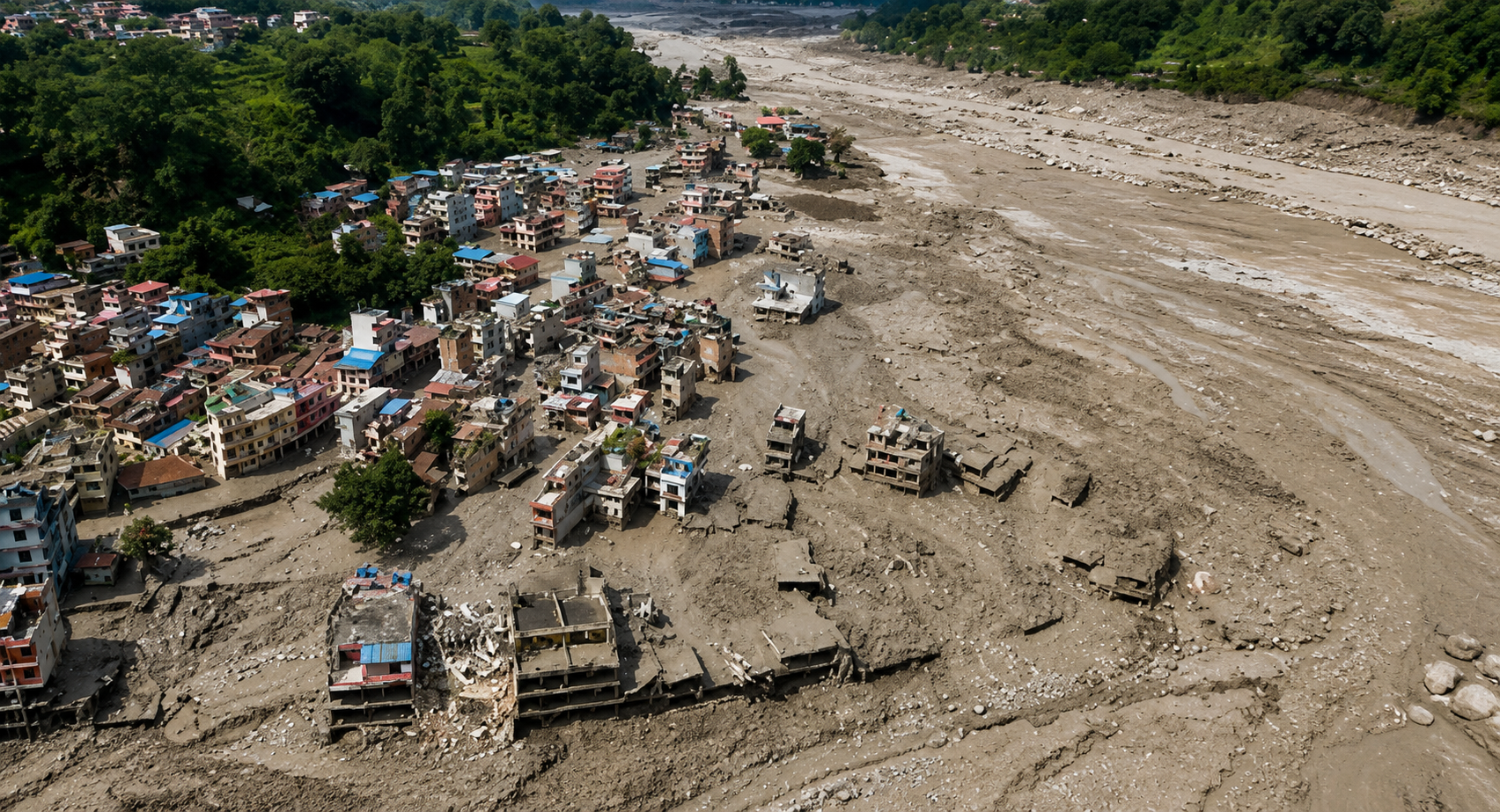
Rescue teams in Nepal and China entered the fourth day of a desperate search on Saturday, as the death toll from a catastrophic flash flood along the two countries' Himalayan border climbed past 600, with nearly 2,500 people still unaccounted for on both sides. Nepali police said more than 2,300 injured survivors are receiving treatment, while officials in China's Tibet region have separately confirmed casualties near a border crossing that was engulfed within moments of the flood hitting on Wednesday morning.
Among the missing are dozens of American citizens and hundreds of other foreign nationals, many of whom were in the region as pilgrims or trekkers drawn to the area's mountain shrines and trails. The scale of the disaster has stunned disaster-response officials in both countries, who describe a wall of mud, rock and ice that swept away entire neighborhoods in a matter of minutes.
A Wall Of Mud And Ice
Scientists studying the disaster believe it began when an ice-rock avalanche from a glacier on the Nepali side collapsed into a river, blocking its flow before releasing a sudden, violent surge downstream. One glaciologist estimated the resulting torrent carried a volume of debris equivalent to roughly 500,000 large dump-truck loads, a mass one researcher described as behaving more like liquid concrete than floodwater as it tore through the Rasuwa and Nuwakot districts of northern Nepal.
Video captured by residents shows roads, bridges and multi-story buildings along the Trishuli River giving way within seconds, with people seen clinging to balconies as the surge passed beneath them. Chinese state media reported that a border checkpoint on the Tibetan side was engulfed almost instantly, with rescue teams so far finding no sign of survivors there.
Foreign Nationals Among The Missing
The border region is a popular gateway for religious pilgrims traveling toward Mount Kailash and for foreign trekkers exploring Nepal's northern valleys, which has complicated the identification effort. South Korean officials said nine of their citizens working on a hydropower project in the area are unaccounted for, while Malaysia's foreign ministry said 11 of its nationals lost contact with local travel agencies. Russia's embassy separately reported four of its citizens missing, and families across the United States, including a couple from New Jersey who had traveled to the region for a religious retreat, have described anguished waits for word of loved ones.
A Race Against The Clock
Officials in Nepal have acknowledged that the so-called 72-hour "golden window" for finding survivors alive has largely closed, though search operations continue with thousands of personnel, including military engineering units equipped with life-detection equipment, deployed by both governments. Rescue efforts have been slowed by collapsed roads, ongoing power outages and forecasts calling for more rain across the affected area this weekend, raising fears of secondary flooding. Authorities are also closely monitoring a newly formed glacial lake upstream that could pose a fresh threat if it breaches.
A Warning Sign For A Warming Himalaya
Disaster-risk researchers note that the region experienced a smaller but similar glacial flood just over a year ago, when a lake in Tibet overflowed amid high temperatures, killing nine people and damaging a bridge connecting the two countries. Specialists in climate-driven glacial hazards say this week's disaster fits a broader pattern of increasingly unstable high-altitude lakes and glaciers across the Himalayas, a trend they link to rising regional temperatures and warn will make early-warning systems increasingly critical for communities living downstream.
International Response
Nepal's government has formally requested rescue assistance from both India and China, and U.S. President Donald Trump said Washington was prepared to send "any help" needed. China's foreign minister acknowledged the "complexity and difficulty" of the joint rescue operation given the mountainous, hard-to-reach terrain on both sides of the border. With search efforts ongoing and communication still down in parts of the disaster zone, officials in both countries have cautioned that the confirmed death toll is likely to keep rising in the days ahead.