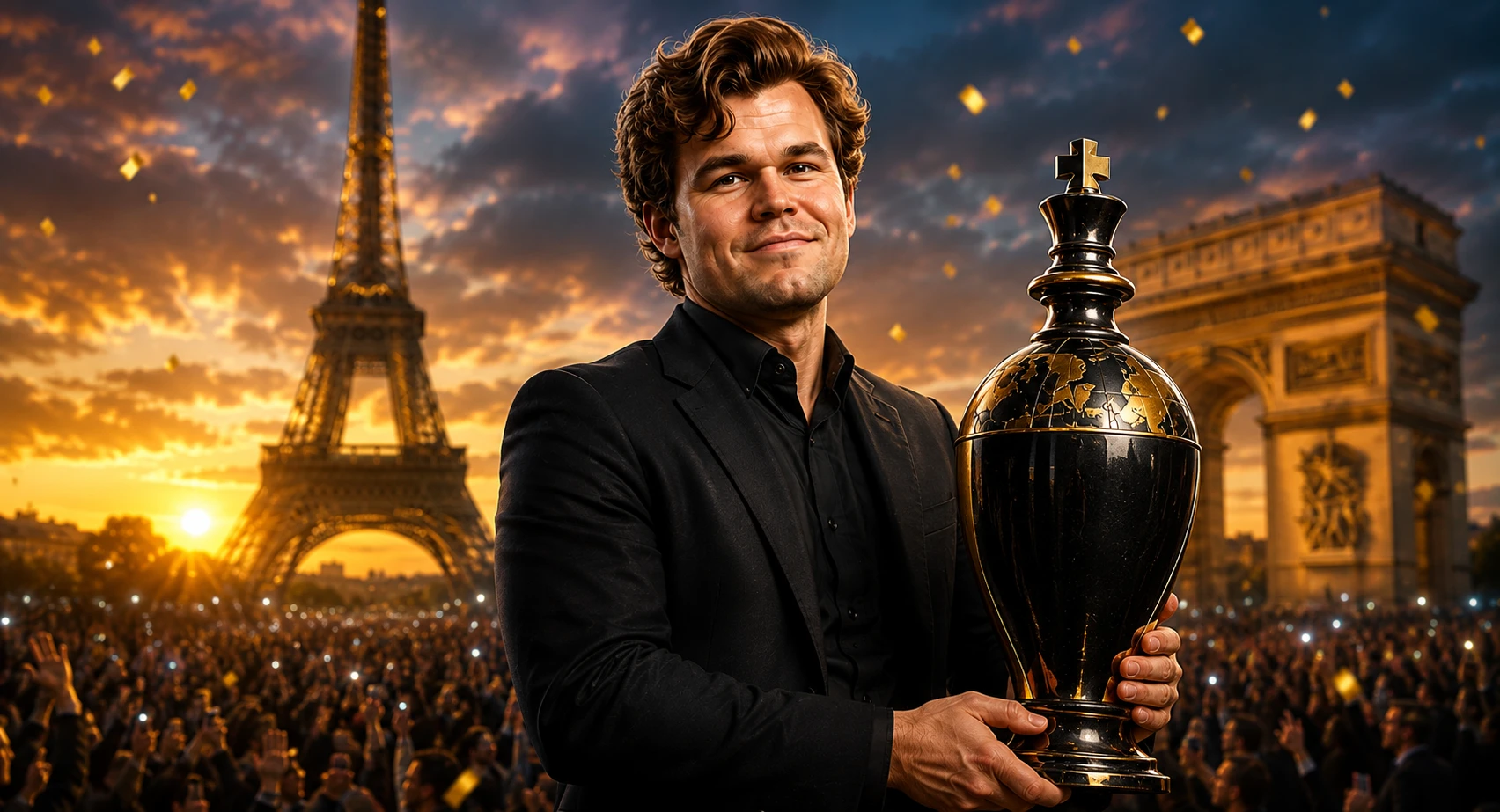
Magnus Carlsen has done it again. A year after winning the inaugural chess event at the Esports World Cup, the Norwegian grandmaster successfully defended his title in Paris on Saturday, beating 19-year-old Belarusian challenger Denis Lazavik in straight sets in the Grand Final without losing a single game across the entire competition.
Carlsen finished the tournament with 11 wins and nine draws, an accuracy rate CNN reported at 99.2 percent, on his way to a $250,000 first-place prize and 1,000 crucial points for his club, Team Liquid, in the event's broader Club Championship standings. It extends a run in which he has never lost a match at the Esports World Cup since the chess event was introduced.
A Dominant, If Understated, Run
The 35-year-old entered the $1.5 million tournament as the heavy favorite, unsurprising given he has held the world number one ranking for a staggering 15 consecutive years, the longest such streak in modern FIDE history. Despite that pedigree, Carlsen played down expectations heading into the event, telling CNN Sports he tries not to think too much about winning and instead focuses on taking each game step by step.
That approach carried him through a stacked 22-player field that included Hikaru Nakamura, Alireza Firouzja, Ian Nepomniachtchi and India's Arjun Erigaisi. Lazavik, representing the AG.AL organization, reached the final on the strength of a playoff run in which he eliminated Nakamura in the semifinals, and he managed to draw four games against Carlsen in the final. He simply couldn't find a way to win one.
Speed Chess Suits Him
The tournament was played at a rapid 10-minute time control with no increment, a fast-paced format that rewards the kind of intuitive, practical decision-making Carlsen has built his reputation on rather than long calculation. Woman Grandmaster and event commentator Nemo Zhou put it bluntly to CNN Sports, calling Carlsen the greatest of all time without hesitation.
Carlsen, who is also a five-time classical world champion and the reigning FIDE Freestyle Chess World Champion, voluntarily gave up his classical title in 2023, saying he no longer felt motivated to defend it. Rapid and freestyle formats, by contrast, have kept pulling him back into competition, and results like this weekend's suggest retirement from the top of the game remains a long way off.
According to Chess.com, last year's Esports World Cup chess event drew close to 260,000 peak concurrent viewers, more than traditional fixtures like Norway Chess and the Tata Steel tournament, a sign of how much audience the faster, higher-stakes format has been able to pull in for a game more often associated with quiet, hours-long contemplation.